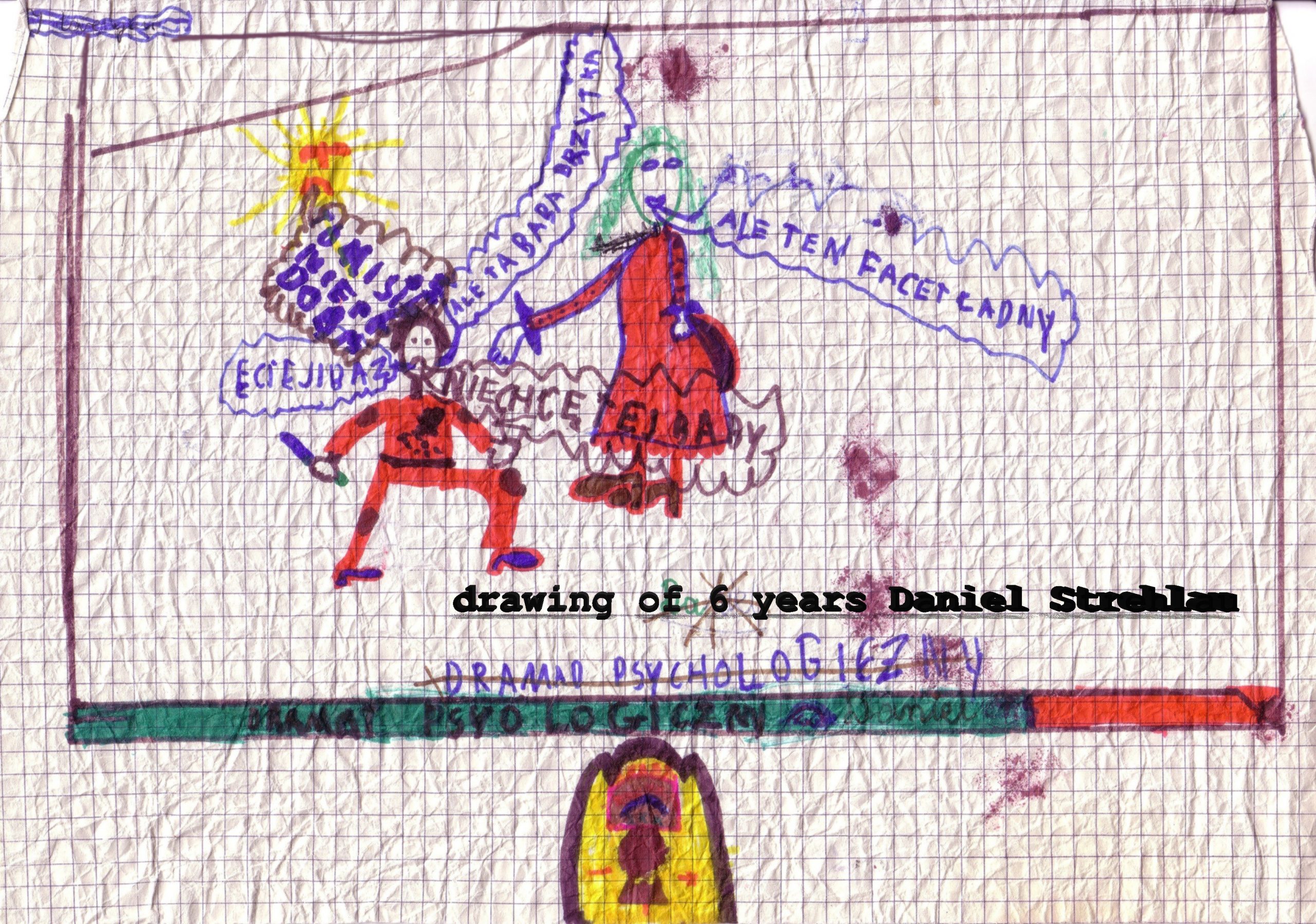
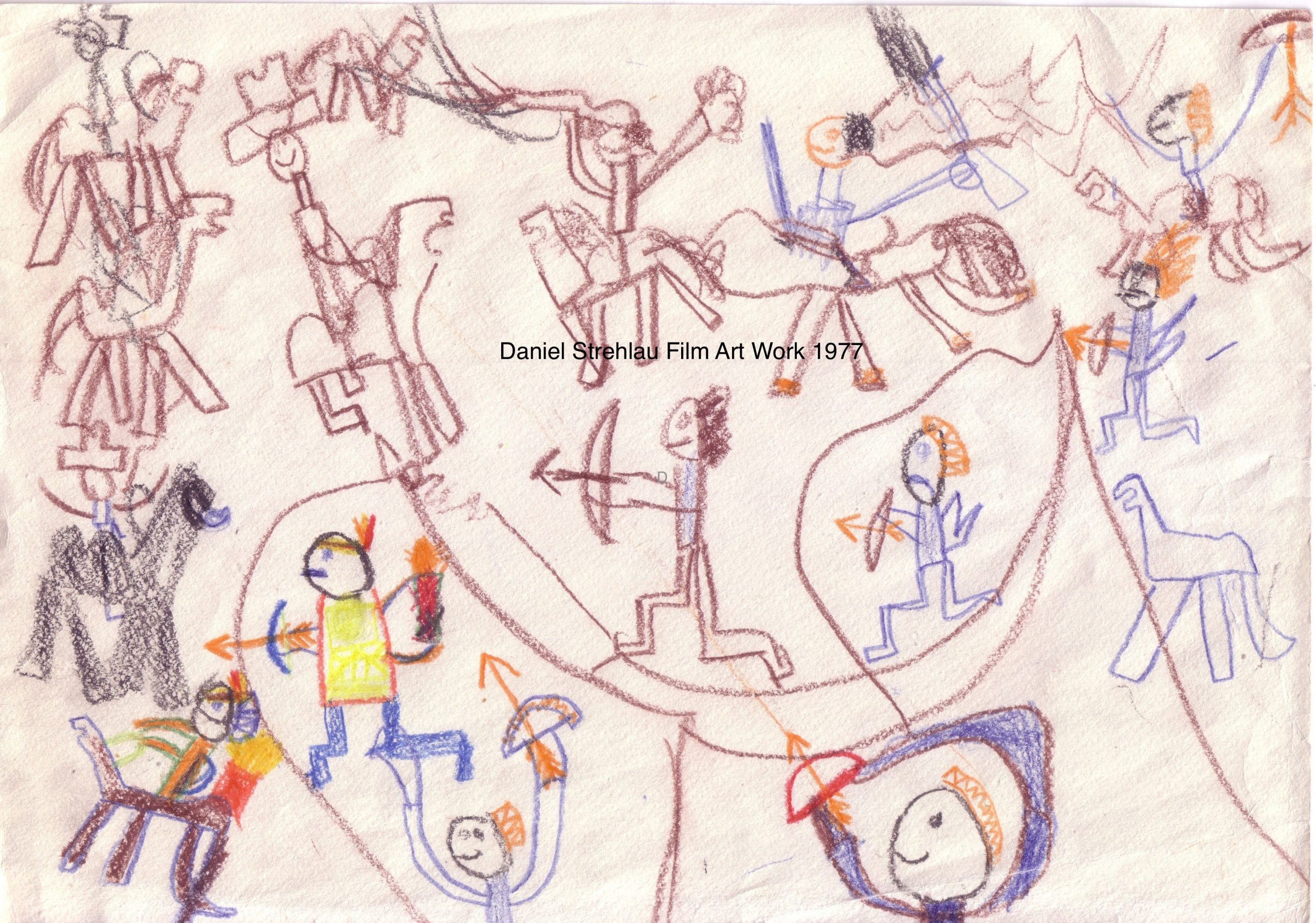
“PSYCHOLOGICAL GRAMA” (1977) – one frame
(the drawing became an inspiration or continuation of Daniel Strehlau’s next film project Jokester)
Description and Interpretation
The drawing, created by a six-year-old Daniel Strehlau, depicts a vivid, emotionally charged scene inside a hand-drawn rectangular “film frame,” showing an early instinct for cinematic composition and storytelling.
Left Character (the man)
The male figure, drawn in red, wears used, patched, and repaired clothing, suggesting hardship or a modest social condition. He holds a knife in his right hand, which introduces tension into the scene. Surrounding him are three internal monologue bubbles written in Polish:
- „Ale ta baba brzydka” (“But this woman is ugly”)
- „Zabiję cię” (“I will kill you”)
- „Nie chcę tej baby” (“I don’t want this woman”)
These reveal the character’s inner conflict, frustration, and emotional resistance.
The Sun as Observer
In the upper left corner is a small sun, drawn with bright yellow and orange rays. The sun has an unhappy expression, represented through its orange lines, suggesting disapproval or sadness.
The sun also comments on the scene with its own speech bubble:
- „To mi się nie podoba” (“I don’t like this”)
This anthropomorphic sun acts as a moral or emotional commentator, observing the tense interaction between the two characters.
Right Character (the woman)
The woman is drawn in a distinguished red dress, with long green hair, and stands in a welcoming, open posture. She extends her hand toward the man in a gesture of warmth and emotional availability.
Her internal monologue reads:
- „Ale ten facet ładny” (“But this guy is handsome”)
This creates a clear contrast between her affectionate openness and the man’s harsh internal thoughts.
The Cinematic Frame
The entire tableau is enclosed within a hand-drawn movie frame, reinforcing the idea that the child perceived this as a film scene.
Below the frame, on a green horizontal bar, is a handwritten attempt at the Polish word „dramat” (“drama”). The six-year-old artist spelled it as „gramat” (“gramma” word style), a typical developmental mistake, showing early attempts at writing even when the letters did not yet perfectly match adult spelling.
Imaginary Film Studio Logo
At the bottom center, beyond the frame, is a stylized, colorful emblem in yellow, purple, and red, resembling the logo of an imaginary film studio — a creative addition showing early world-building imagination.
Interpretation
The drawing blends narrative conflict, emotional contrast, humor, and cinematic structure. Despite being created by a six-year-old, it demonstrates:
- early awareness of character psychology
- instinctive understanding of story conflict
- use of internal monologue
- symbolic commentary (the sun as observer)
- the framework of a film scene
- imaginative world-building (studio logo)
The result is a unique, expressive childhood artwork with seeds of dramaturgy and film direction already present.
Later Daniel Strehlau collected money for 8 months for his first motion camera Lomo 219 Super 8 MM to make his first movies.